How Fast DB Unloads Help AI Workflows
To begin with, data may need to be extracted from a database before AI models and analytics tools can use it. This is where a robust database unload tool comes into play. In turn, it helps developers, data engineers, and AI teams offload production data quickly and securely. They can then use that data for exploration, machine learning, and advanced analytics.
In particular, fast and structured data unloading is essential for AI products, business analysis, and real-time dashboards. The process lays the foundation for quality input, minimal latency, and meaningful outcomes. As data volumes grow, the right unload tool becomes more important. It helps deliver clean, consistent, and complete datasets to downstream AI workflows.
Why Database Unload Tools Are Foundational for AI
Think of AI as a high-performance engine. The fuel? Raw data. But raw data isn’t always ready for use. That’s where database unload tools step in. Specifically, these tools streamline data extraction from relational and non-relational sources. They support high-throughput AI pipelines without slowing production systems.
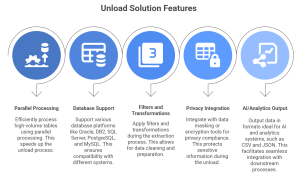
At a glance, a powerful unload solution should offer:
- Efficient parallel processing for high-volume tables
- Support for various database platforms (e.g., Oracle, DB2, SQL Server, PostgreSQL, MySQL)
- Options to apply filters and transformations during extraction
- Integration with data masking or encryption tools for privacy compliance
- Output in formats ideal for AI and analytics systems (e.g., CSV, JSON)
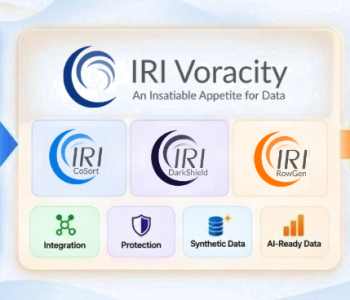
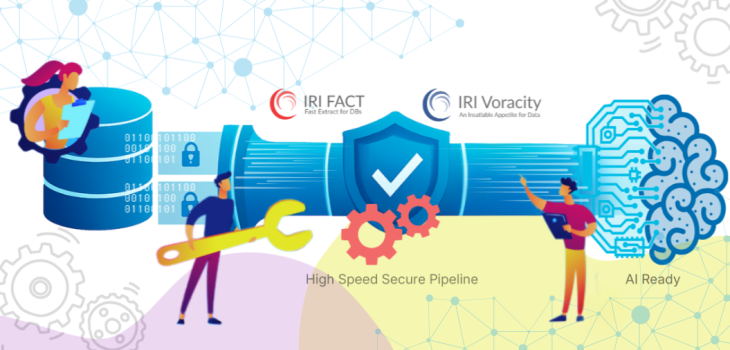
IRI Fast Extract (FACT) and IRI Voracity are hand-in-glove examples. Moreover, these tools unload large tables quickly and integrate with transformation, masking, and metadata frameworks. This makes them well suited to enterprise AI workflows.
The Importance of Database Extract and Format Flexibility
When working with AI models, having data in the right format matters. That’s why database extract functions in unload tools must go beyond mere duplication. For this reason, modern AI ecosystems need clean, relevant data in formats that machine learning platforms can use efficiently.
Additionally, the IRI unload approach supports filtering, sorting, joining, and de-duplication during extraction. This minimizes post-processing time and empowers AI teams to focus on modeling rather than data cleaning. At the same time, column-level encryption and data masking can protect PII while preserving referential integrity.
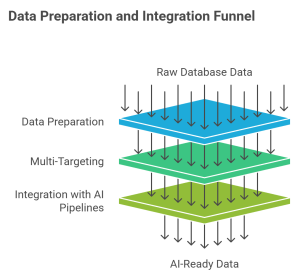
Likewise, Voracity can send prepared data directly to data lakes, cloud buckets, or NoSQL stores. This supports easier integration with AI pipelines and big data platforms.
Real-Time and Batch AI Pipelines: How Unload Tools Fit
Every AI pipeline starts with data ingestion. A database unload tool like FACT optimizes this step by providing structured data (flat files) directly from production or staging databases.
In batch pipelines, the tool can offload data at scheduled intervals, preserving system performance and ensuring data freshness.
In real-time or near-real-time pipelines, incremental unloads or change data capture (CDC) solutions like Ripcurrent in Voracity can keep the AI models up to date without full reloads.
Using these tools together gives teams the flexibility to perform delta unloads, replicate tables, and format data for instant AI model training or scoring—using consistent, scriptable jobs supported in the IRI Workbench GUI, built on Eclipse.
These capabilities allow for a plug-and-play approach into cloud-based ML environments like AWS SageMaker, Azure Machine Learning, or Google Vertex AI.
How Unload Tools Support Compliance and Scalability

AI workflows in regulated industries like healthcare, finance, and telecom often involve sensitive data. That means compliance with HIPAA, GDPR, and other data privacy frameworks is non-negotiable. Modern approaches that integrate data masking during extraction help maintain regulatory standards without extra steps.
Moreover, they scale horizontally. Whether you’re offloading one small table or 100TB of structured records, performance should remain optimal. IRI unload features are built for scale, offering parallelism, job scheduling, and integration with BI, data science and AI tools like Datadog, Splunk and KNIME.
Choosing the Right Unload Tool for Your AI Use Case
To select the best database unload tool, consider your organization’s:
- Data volume and velocity
- Types of AI workloads (batch vs real-time)
- Data security and compliance requirements
- Existing tech stack and integration needs
- Preferred output formats for modeling or dashboards
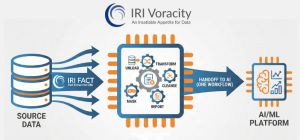
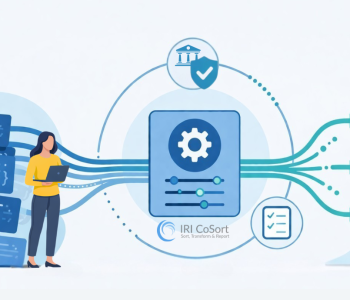
Combining IRI FACT with Voracity gives you flexibility across all five dimensions. The ETL process that combines the multithreaded extraction speed of FACT and data transformation power of the CoSort engine in Voracity means you can rapidly unload, transform, cleanse, mask, and report or handoff data to AI within one workflow.
Learn more about database unloading from this article in the IRI Data Education Center.
Frequently Asked Questions (FAQs)
What is a database unload tool and how is it different from a simple export?
A database unload tool is designed to efficiently extract large volumes of structured data while supporting transformations, filtering, masking, and formatting during extraction. Unlike basic export features, it’s optimized for high-performance and integration into downstream analytics or AI systems.
Why is database unloading important for AI pipelines?
AI models need structured, clean, and relevant data. A reliable unload tool ensures high-throughput, low-latency extraction of such data directly from operational databases, feeding AI models without compromising source system performance.
Can database unload tools help with data privacy regulations like HIPAA or GDPR?
Yes. Advanced unload tools integrate data masking, encryption, or tokenization during the extraction process, enabling compliant workflows from the start.
What formats do modern database unload tools support?
Tools like IRI Voracity support a wide range of output formats, including CSV, JSON, Parquet, XML, Avro, and more—making them suitable for both traditional analytics platforms and modern machine learning tools.
Final Thoughts
With AI becoming more embedded in business processes, the role of a high-performance database unload tool has never been more critical. From speeding up data prep to ensuring privacy and supporting massive pipelines, it’s the hidden engines that make AI work. As the demand for real-time insights grows, so does the need for flexible, secure, and scalable unload solutions.
If you’re planning to build robust and compliant AI pipelines, start with the foundation—powerful data extraction. Learn more about IRI unload and transformation solutions here.