
What’s New in CoSort 11
Abstract: Version 11 of IRI CoSort® represents a major evolution of IRI’s high-performance data transformation engine, extending well beyond speed and scalability improvements into operational governance, metadata intelligence, cloud interoperability, and enhanced SortCL expressiveness. Recent development focus has shifted toward production controls, auditability, and consistency across increasingly distributed, regulated, and hybrid data environments. This article highlights key new features in CoSort 11, which also benefit IRI Voracity platform users.
Operational Governance System (OGS)

One of the most significant additions in CoSort 11 is the Operational Governance System (OGS)—a new runtime framework that brings policy-based control, auditing, and tamper detection to SortCL job execution.1
OGS adds a dedicated CLI runtime layer that allows administrators to define granular role-based access control (RBAC) policies governing:
- Who may run specific jobs
- Which scripts or script elements may be accessed
- What actions are users, groups, or roles permitted to perform on sensitive data
In addition to enforcement, OGS generates a comprehensive JSON performance and audit log for every run, detects script tampering through hash-based signatures, manages date-based log retention, and supports basic data descriptions for cataloging purposes. Menu-driven tools are included to simplify policy file management and log analysis for reporting and compliance.
New SortCL Runtime JSON Log Format
CoSort 11 introduces a new default JSON runtime log that consolidates performance metrics, execution metadata, and audit details into a single, machine-readable artifact.
This log:
- Supersedes
/AUDIT XML - Obsolesces
cosort.log - Replaces
/STATISTICS
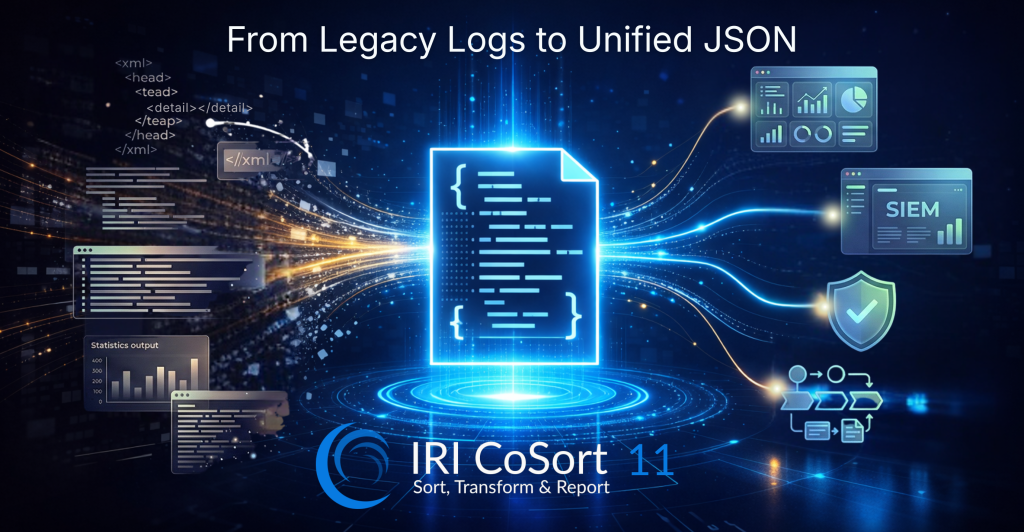
All prior log formats (except.cserrlog) are now deprecated, meaning they remain available but are no longer supported. Log content can be customized through OGS policy files, making the new format suitable for:
- SIEM ingestion
- Performance trending
- Regulatory audits
- Automated reporting pipelines
Cloud File Store Support
CoSort 11 expands its native I/O capabilities with read and write support for flat files stored in major cloud object platforms, on both Windows and Linux:
- AWS S3
- Google Cloud Storage
- Azure Blob Storage
- OneDrive (sync)
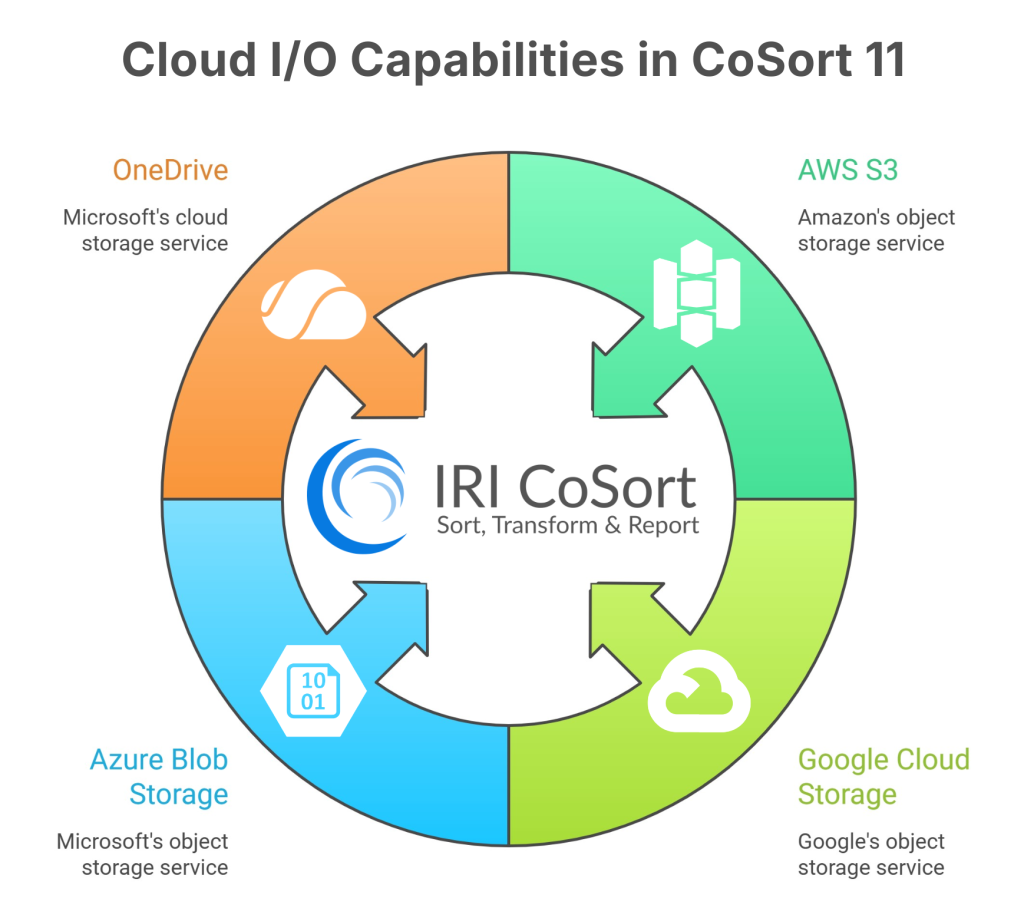
This allows SortCL jobs to operate directly on cloud-resident data without staging or manual transfers, enabling modern hybrid and cloud-native architectures.
For additional context, see this related article on Voracity cloud file store support.
Nested Functions in /FIELD Statements
SortCL now supports nested functions within/FIELD declarations, enabling multiple transformations to be applied in a single expression.
For example, users can now:
- Extract a substring,
- Encrypt the result, and
- Reformat the encrypted output value
— all within the same field definition. This improves both job readability and processing efficiency, particularly in masking, transformation, and synthesis workflows.
Improved Null Handling
CoSort 11 also improves null value processing across both file-based and relational data sources. These enhancements provide more predictable behavior when transforming mixed or incomplete datasets and reduce the need for defensive logic in job scripts.
ODBC2DDF Enhancement for PD Conversion
The ODBC2DDF utility now includes a new -M argument in its CLI version. This option multiplies numeric database values by the appropriate power of ten to remove decimals while retaining all digits—allowing accurate conversion to packed decimal (MF_CMP3) fields in SortCL.
This enhancement simplifies schema generation and improves precision when integrating relational data with mainframe-compatible formats.
RDB Catalog Support Beyond the Schema Level
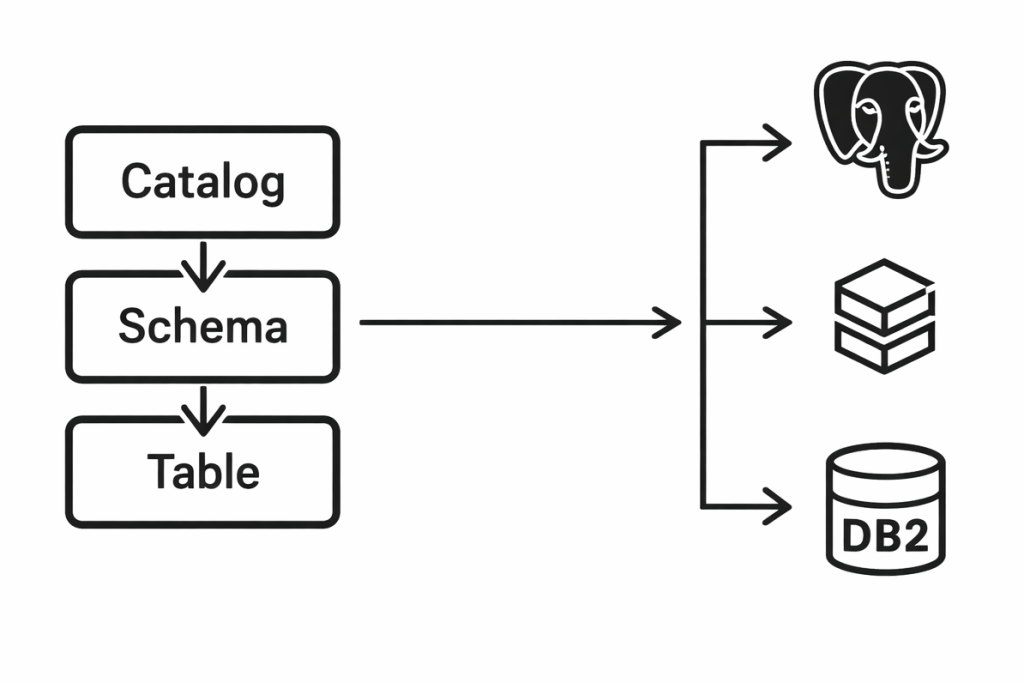
Both SortCL and IRI Workbench now fully support qualified RDB references using:
Catalog.Schema.Table
for PostgreSQL, Databricks, and DB2 sources and targets. This enables CoSort-driven jobs to operate consistently in:
- Modern environments using Unity Catalog
- Legacy environments without catalog support
The result is improved portability and compatibility across evolving database platforms.
AI-Assisted JCL Sort Parm Migration (In Progress)

IRI is developing a web-based AI-assisted portal that converts z/OS DFSORT parameters into functionally equivalent SortCL scripts, surpassing the capabilities of the legacy MV2SCL CLI utility. This tool is designed to:
- Improve conversion accuracy
- Handle more complex DFSORT constructs
- Reduce manual migration effort
A test version of the portal is already available on the IRI website.
New and Expanded Set Files
CoSort 11 distributions include new and expanded external datasets (“set files”) used for:
- Data classification (discovery)
- Pseudonymization (replacement)
- Test data generation (synthesis)
Enhancements include:
- New country-specific and global standards
- A significantly larger corpus of realistic personal names
- Values derived from U.S. government and international sources
These improvements enhance both the realism and coverage of data protection and test data workflows. The sets subdirectory contains the available content, and this article explains its uses in detail.
Database Type Mapping Wizard in IRI Workbench
A new DB Data Type Mapping wizard in IRI Workbench simplifies SortCL-compatible job (e.g., CoSort or FieldShield) integration between relational databases that use different data type names.
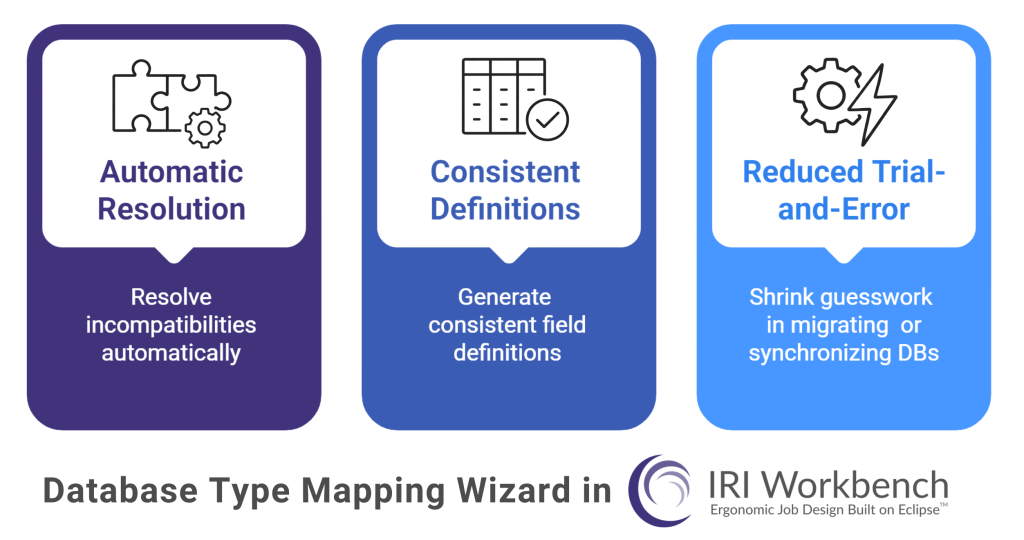 This wizard helps users:
- Resolve incompatibilities automatically
- Generate consistent field definitions
- Reduce manual trial-and-error when migrating or synchronizing databases
The result is faster, more reliable cross-platform data movement.
New Data Classification Infrastructure
The IRI Workbench GUI for CoSort and other SortCL-compatible tools in Voracity now uses a new and improved data classification architecture that supports:
- Project-specific data classes
- Sharable data class for multiple projects
- Centralized data rules for data masking, migration, and synthesis
These classifications appear consistently at the field level in SortCL-compatible job scripts and replace the older preference-based data class rules previously defined in Workbench.
This change improves scalability, reuse, and governance, particularly in enterprise environments with many projects and teams.
Data Class Attribution in /FIELD Statements
CoSort 11 enhances SortCL metadata awareness and RBAC for data classes by supporting optional data class definitions directly in /FIELD statements:
/FIELD=(ssn, POSITION=1, SIZE=9, CLASS=US_SSN)
TheseCLASS=declarations map Workbench-defined data class names to specific source and target fields. IRI Workbench currently generates this automatically in FieldShield® data masking job scripts, but the feature is extensible to more wizards and job types in upcoming releases.
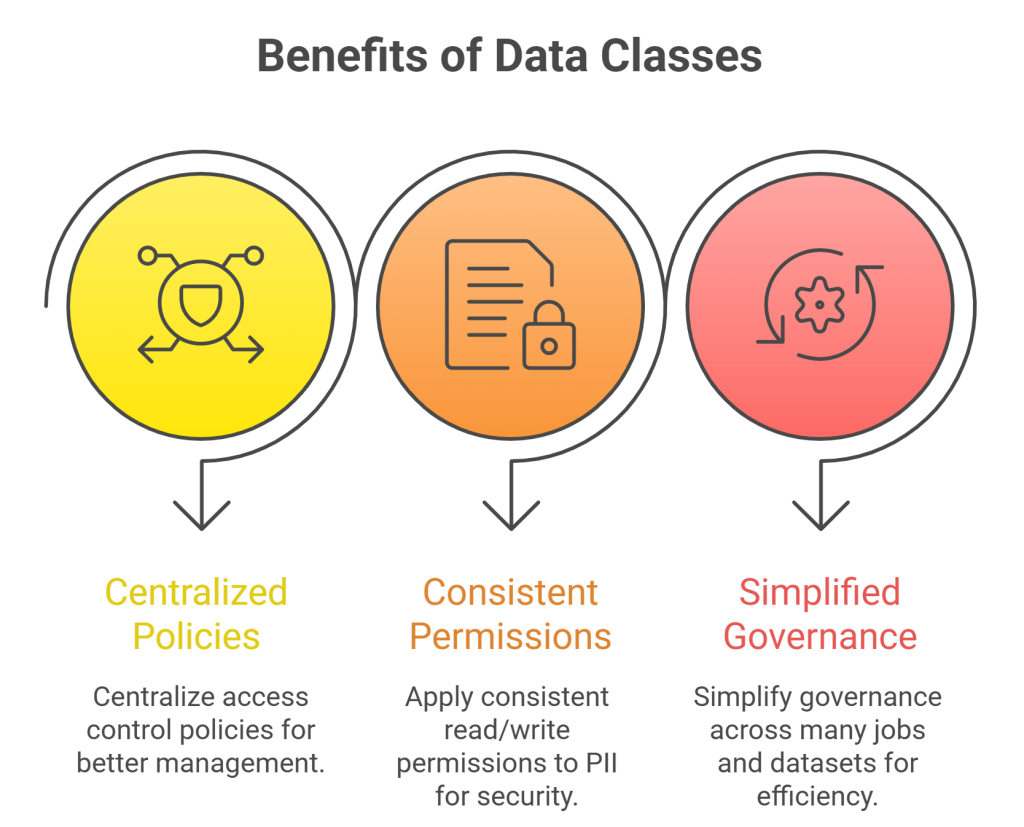
By associating fields with data classes instead of managing permissions at the field level, organizations can:
- Centralize access control policies
- Apply consistent read/write permissions to PII
- Simplify governance across many jobs and datasets
This approach supports OGS-enforced RBACs at the data class level, not just the script level.
If you have any questions about these updates or would like to evaluate CoSort Version 11 in your Windows or Linux environment, please email us at cosort@iri.com.