Enterprise AI Data Readiness: Preparing Trusted Data for AI
The next wave of enterprise AI will not be limited by the availability of models. It will be limited by the availability of trusted, realistic, and usable data.
Organizations investing in generative AI, retrieval-augmented generation (RAG), intelligent agents, and machine learning initiatives are discovering a fundamental challenge: the data required to power these systems often cannot be used as-is.
Enterprise information is fragmented across databases, files, applications, cloud platforms, and content repositories. It can contain personally identifiable information (PII), financial records, healthcare information, intellectual property, and other sensitive content that organizations cannot simply copy into AI development environments.
At the same time, removing too much information can reduce the quality and usefulness of AI systems.
The solution requires a new approach: creating AI-ready data that is realistic enough to support innovation while protected enough to satisfy security, privacy, and compliance requirements.
That is the foundation of the IRI Voracity data preparation platform.
AI Requires More Than Masking Production Data
Traditional approaches to protecting enterprise information often focus on masking production data or restricting access to it. Those techniques remain important, but AI introduces additional data requirements.
AI teams need data for:
- Training and evaluating models
- Building retrieval-augmented generation systems
- Testing AI applications before deployment
- Creating realistic development environments
- Validating AI behavior against unusual scenarios
- Sharing information safely across teams and partners
In many cases, production data alone is not enough. Organizations may need additional records, rare scenarios, balanced datasets, or entirely new examples that do not exist in operational systems.
Synthetic data generation and intelligent data protection provide a more flexible way to address those requirements.
Creating Safe Realism with Synthetic Data
Synthetic data is becoming an important capability for enterprise AI because it allows organizations to create realistic information without exposing real individuals or confidential business data.
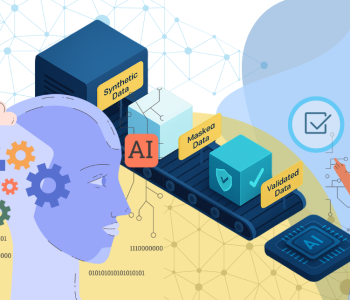
IRI RowGen generates synthetic datasets based on defined rules, characteristics, and relationships. Instead of simply copying and anonymizing production records, RowGen can create entirely new data while maintaining realistic structures, distributions, and referential integrity.
This enables organizations to:
- Generate large-scale datasets for AI training and testing
- Create edge cases and rare scenarios that may not exist in production
- Populate development, analytics, and cloud environments safely
- Support application modernization and performance testing
- Provide realistic data for experimentation without privacy concerns
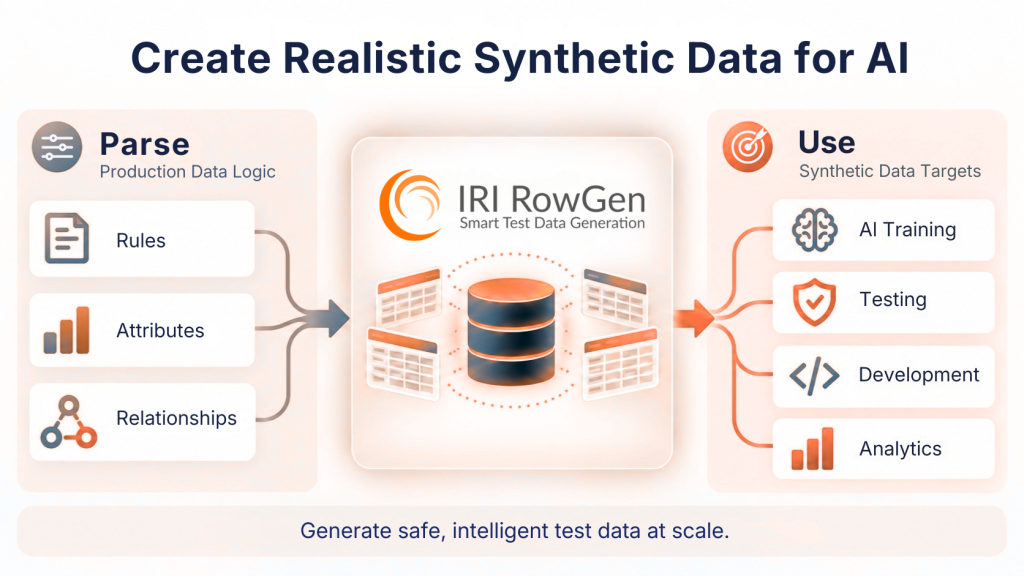
For AI initiatives, the objective is not simply anonymous data. It is safe realism: information realistic enough to support useful results while eliminating unnecessary exposure of sensitive records.
This distinction is important. Masking existing information can protect production values, while synthetic data generation can create entirely new records when existing production data is insufficient, inappropriate, or unavailable for the intended AI workload.
Protecting and Transforming Data for AI Use
Synthetic data is only one part of AI readiness. Many AI applications also depend on existing enterprise knowledge found across structured, semi-structured, and unstructured sources.
Documents, files, images, JSON, XML, databases, and other repositories may contain valuable information needed for AI systems, but they may also contain sensitive content that must be protected.
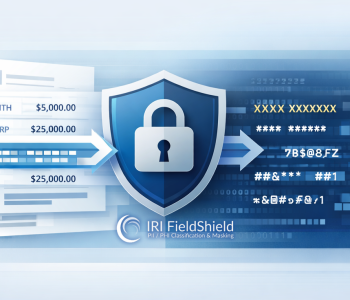
IRI DarkShield helps organizations discover sensitive information across diverse data sources and transform it into safer, AI-ready information. DarkShield can mask confidential values or replace them with realistic synthetic equivalents while preserving useful structure, context, and meaning.
This capability is particularly relevant to:
- Retrieval-augmented generation systems
- AI assistants
- Enterprise search
- Intelligent agents
These applications often depend on large collections of organizational knowledge. Simply removing sensitive information can also remove useful context.
Instead, organizations can create protected versions of their information that remain useful for analysis, testing, and model evaluation while reducing unnecessary exposure of sensitive records.
A Complete AI Data Preparation Environment
For many enterprises, the challenge is not a lack of individual data tools. The problem is the complexity that results when those tools operate separately.
AI projects may require several data preparation processes before information is ready for use, including:
- Data discovery
- Data transformation
- Data cleansing
- Data integration
- Data quality improvement
- Data protection
- Synthetic data generation
- Data governance
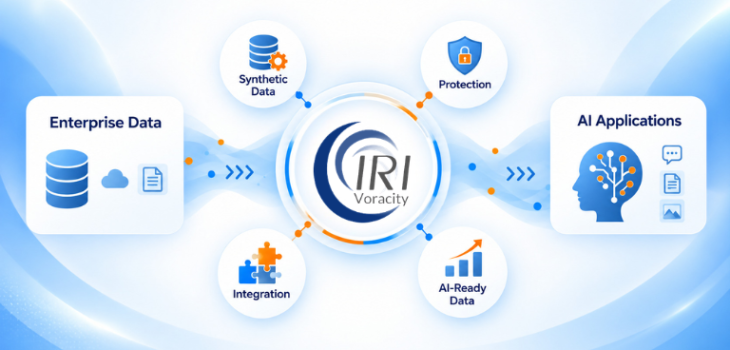
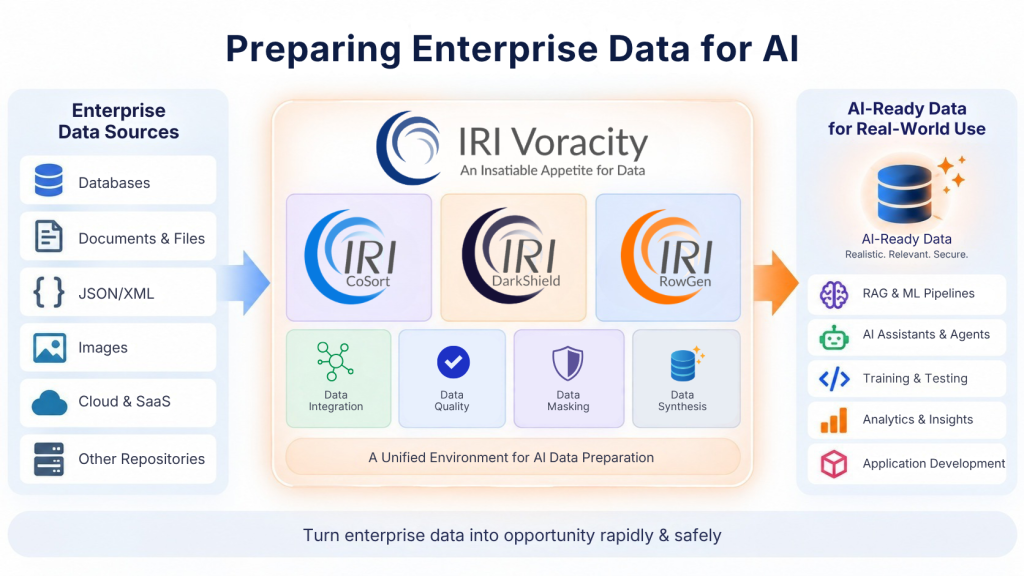
IRI Voracity addresses these requirements within a common environment by combining:
- Synthetic data generation through RowGen
- Sensitive data discovery, masking, and synthetic replacement through DarkShield
- High-performance data processing through the CoSort/SortCL engine
- Data integration and ETL
- Data quality improvement
- Data transformation and preparation
- Data classification and governance capabilities
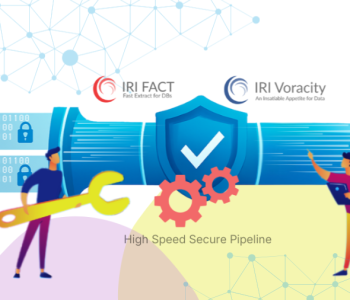
This integrated approach allows organizations to build repeatable AI data pipelines rather than manually preparing data for each new AI initiative.
The relationship between these capabilities is important. RowGen can create entirely new synthetic data, DarkShield can discover and protect sensitive information in existing enterprise sources, and the broader Voracity environment provides the processing, integration, transformation, quality, classification, and governance capabilities needed to prepare information for AI use.
A Different Approach to AI Data Readiness
Many enterprise data platforms evolved around application testing, database virtualization, or managing protected copies of operational systems. Those capabilities remain useful, but AI initiatives require a broader strategy.
Modern AI programs increasingly require organizations to:
- Generate new synthetic datasets
- Protect information across many data types and locations
- Improve data quality before AI consumption
- Prepare knowledge sources for RAG and AI agents
- Support continuous experimentation and model improvement
This is where IRI takes a different approach.
Rather than focusing only on making existing production data available, IRI focuses on helping organizations create, protect, improve, and operationalize trusted data for emerging AI workloads.
Performance and Enterprise Scale Matter
AI data preparation is increasingly a large-scale engineering challenge. Organizations may need to process billions of records, prepare massive datasets, and support rapidly changing AI initiatives across hybrid environments. At that scale, data preparation performance becomes part of the overall AI architecture.
IRI Voracity uses high-performance data processing capabilities designed for demanding enterprise workloads. Through optimized execution, parallel processing, and efficient data transformation workflows, organizations can prepare large volumes of information without introducing unnecessary complexity or data movement.
This enables AI teams to move faster while reducing the operational burden of managing multiple disconnected data preparation platforms.
Trusted Data Is the Foundation of Trusted AI
The organizations that gain the greatest value from AI will not simply be those with access to the largest models. They will be those capable of continuously creating, protecting, improving, and delivering trusted data.
Synthetic data generation and intelligent data protection are becoming essential components of enterprise AI strategy.
By using RowGen and DarkShield in the broader AI data preparation capabilities of IRI Voracity, organizations can build AI-ready data foundations that accelerate innovation while maintaining privacy, security, and governance.
The future of enterprise AI depends on trusted data. Preparing that data effectively is where successful AI initiatives begin.
Frequently Asked Questions
Why isn’t production data alone sufficient for enterprise AI?

Production data may contain sensitive information that organizations cannot safely copy into AI development environments. It may also lack the additional records, rare scenarios, balanced datasets, or new examples required for AI training, testing, and evaluation.
How does IRI RowGen support enterprise AI projects?
IRI RowGen creates entirely new synthetic datasets based on defined rules, characteristics, and relationships. It can maintain realistic structures, distributions, and referential integrity for use in AI training, testing, development, analytics, application modernization, and performance testing.
What does DarkShield do for AI data preparation?
IRI DarkShield discovers sensitive information across diverse data sources and can mask confidential values or replace them with realistic synthetic equivalents. This allows organizations to create protected versions of enterprise information while preserving useful structure, context, and meaning.
How do RowGen and DarkShield differ?
RowGen generates entirely new synthetic datasets based on defined rules and relationships. DarkShield works with existing information by discovering sensitive content and masking it or replacing sensitive values with synthetic equivalents. Both capabilities operate within the broader IRI Voracity data preparation environment.
What capabilities does Voracity provide for AI data preparation?
Voracity combines RowGen synthetic data generation, DarkShield discovery and data protection, CoSort/SortCL high-performance processing, data integration and ETL, data quality improvement, data transformation and preparation, and data classification and governance capabilities. Together, these capabilities support repeatable AI data preparation pipelines.
For more technical details, see this article and follow the IRI company page on LinkedIn.