
Data Preparation for AI
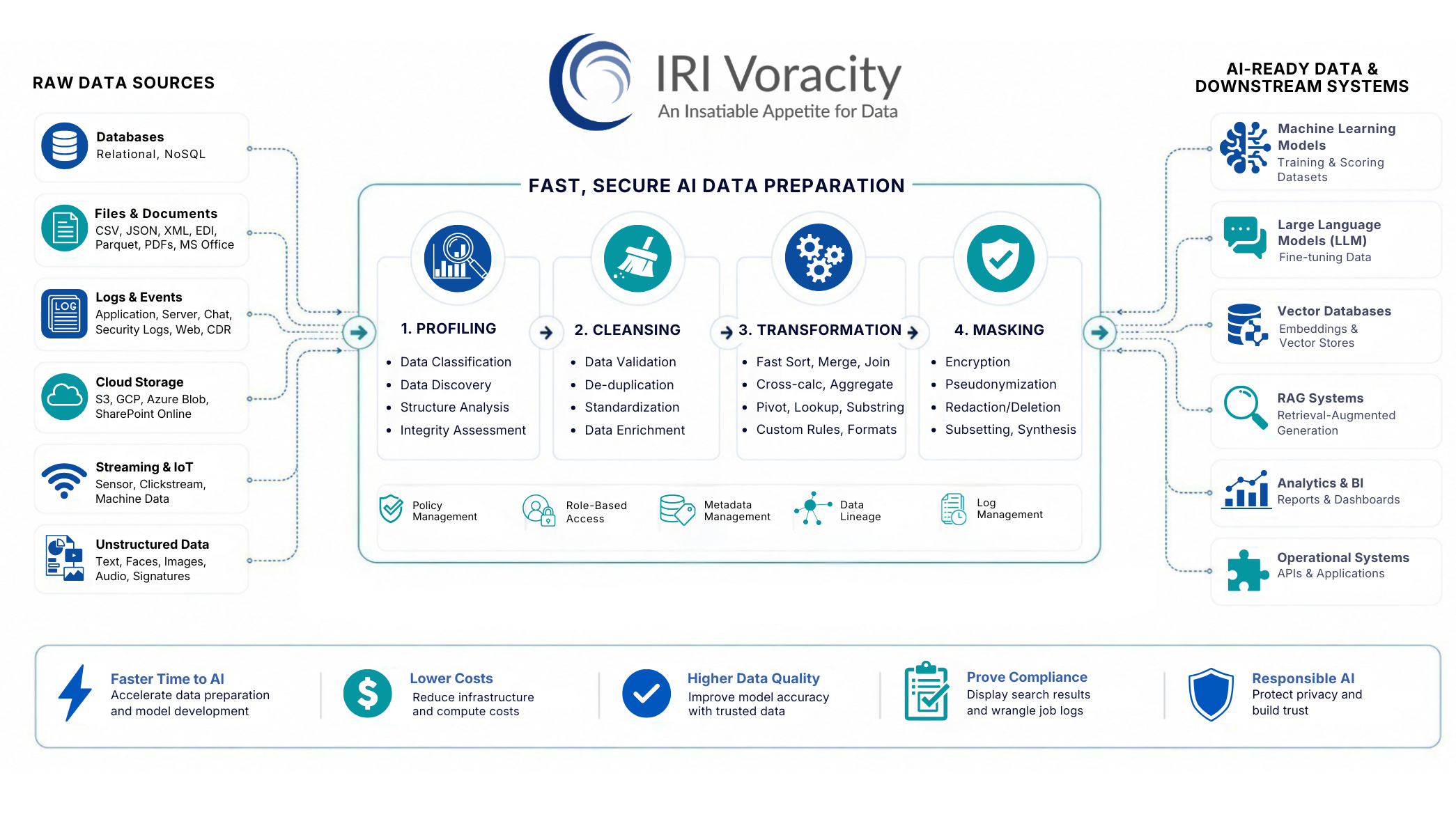
Artificial intelligence depends on clean, consistent, and well‑structured data. The IRI Voracity data management platform, powered by the IRI CoSort big data manipulation engine and including the IRI DarkShield multi-source masking tool, prepares massive datasets with the speed, governance, and transformation breadth required for machine learning and large‑language‑model (LLM) workloads.
With Voracity, you can accelerate AI and analytics pipelines, improve model accuracy, and reduce compliance risk by unifying data wrangling, data quality, masking, and metadata management in one platform.
- Between 5 and 15X faster than large ETL stacks per third-party benchmarks
- 80% less manual wrangling through integrated profiling, transformation, and governance
- Built‑in masking and auditing to support GDPR, HIPAA, and responsible AI initiatives
Why Fast Data Wrangling Matters for AI
Most AI initiatives spend far more time preparing data than training models. Slow, fragmented pipelines keep GPUs idle, delay experiments, and make it harder to trust results. Voracity users can reduce that imbalance by:
- Shortening the time and cost of preparing large and diverse datasets
- Improving data quality before it reaches the model or LLM
- Enabling more frequent retraining and experimentation
- Supporting governance, lineage, and compliance requirements across AI workflows
The parallelized sorting, transformation, masking, and metadata management capabilities of Voracity directly support the needs of AI engineers who must move fast without sacrificing control.
Who Uses Voracity for AI Data Prep?
Data architects: Build high‑speed, reusable pipelines without stitching together multiple tools
ML engineers: Create clean, feature‑rich training sets and embeddings that improve model performance
Analytics leaders: Deliver trusted insights faster, with less dependency on ad hoc scripts
GRC and data security officers: Enforce masking, lineage, and auditability across AI data flows
BI professionals: Prepare and blend data for dashboards and reports alongside AI workloads
Before and After Voracity
Before Voracity
Fragmented scripts: Python, SQL, and shell jobs scattered across servers and users
Slow pipelines: Multi‑pass processing that keeps GPUs waiting for data
Unclear lineage: Limited visibility into how data was transformed or masked
Compliance anxiety: Risk of PII and PHI slipping into training sets and logs.
After Voracity
Single platform: One place to profile, transform, mask, and deliver data for AI
Single‑pass performance: Sort, join, aggregate, and mask in one high‑speed flow
End‑to‑end lineage: Clear visibility from source to model input and output
Governed AI: Built‑in masking, role‑based access, and audit trails for sensitive data
High‑Speed Preparation for Large Training Sets
AI workloads often involve terabytes of logs, transactions, sensor data, or text. The CoSort engine in Voracity:
- Sorts, joins, and transforms huge datasets faster than typical open‑source ETL stacks
- Performs multiple operations in a single I/O pass to reduce latency and I/O overhead
- Reduces infrastructure cost by completing pipelines more efficiently
This gives data scientists training‑ready datasets sooner and keeps compute resources fully utilized instead of waiting on slow data prep jobs.
Prepare Clean, Trusted Data for AI and Machine Learning
IRI helps you profile, cleanse, mask, and transform data so it's ready for AI and analytic pipelines. Tell us about your requirements.
Talk to an EngineerImproving Data Quality for Better Model Accuracy
Voracity includes profiling, cleansing, and validation features that:
- Detect anomalies, duplicates, and missing values before they pollute features
- Standardize formats and resolve inconsistencies across sources
- Apply business rules before data reaches the model or LLM
Cleaner data reduces noise and improves the reliability of features, often boosting model performance more than hyperparameter tuning alone.
Governance, Masking, and Responsible AI
AI initiatives increasingly require privacy protection, bias control, and auditability. Voracity supports:
- Discovery and masking of sensitive data in structured, semi‑structured, and unstructured sources
- Classification of demographic and other attributes to find and redact personal traits and preferences
- Metadata lineage and operational logs to trace data flows and transformations
- Policy‑driven masking functions and role‑based access controls
- Alignment with GDPR, HIPAA, and other regulations
These capabilities help organizations train models responsibly and maintain trust in AI outputs.
Accelerating ML Engineering Cycles
Model development is iterative: extract → clean → transform → train → evaluate → repeat.
Voracity accelerates the slowest steps by enabling:
- Rapid reprocessing of updated or expanded datasets
- Reusable workflows for recurring training and scoring jobs
- Consistent data quality and masking across experiments and environments
The result is faster experimentation, more reliable models, and smoother promotion from development to production.
Preparing Data for LLMs, RAG Pipelines, and Vector Databases
Voracity can prepare and govern the data used for LLM training and retrieval‑augmented generation (RAG), including:
- Chunking and normalization of text and documents
- Embedding prep and feature creation for semantic search
- Metadata management for retrieval and ranking
- Masking of sensitive content before it enters vector stores or models
This helps you build LLM and RAG solutions that are both powerful and compliant.
Why Voracity Instead of Scripts, Spark, or Cloud‑Only Tools?
Many people start with Python scripts, Spark jobs, or cloud‑native ETL services. Voracity is designed to replace or complement those approaches when performance, governance, and simplicity matter.
|
Capability |
Voracity |
Typical Open‑Source Stack |
Cloud‑Only ETL |
|---|---|---|---|
|
Single‑pass high‑speed transforms |
Yes (CoSort engine and accelerators) |
Often multi‑pass, script‑based |
Depends on service and configuration |
|
Built‑in masking and governance |
Native masking, metadata, lineage |
Requires custom code and add‑ons |
Varies; often separate services |
|
Multi‑format file and DB support |
Yes, including large flat files |
Often focused on specific formats |
Strong for cloud sources, weaker on legacy files |
|
Unified platform for analytics, ML, and LLM |
Yes |
Requires stitching multiple tools |
May require multiple services and vendors |
Bottom line: Voracity is ideal when you need high‑speed, governed data prep across diverse sources and AI workloads, without building and maintaining a patchwork of scripts and services.
How Our Customer Prepared Data for AI
A global insurer replaced a mix of Python scripts and legacy ETL with Voracity for its risk modeling and LLM‑based document analysis workflows.
42% reduction in end‑to‑end data pipeline time for model training
30% improvement in model accuracy after systematic data profiling and enrichment
Full lineage and masking for sensitive customer data across AI and analytics use cases
The result? Faster experimentation, more reliable models, and a clearer governance story for regulators and internal stakeholders.
Frequently Asked Questions
1. How is Voracity different from traditional ETL tools?
Voracity combines high‑speed data transformation, data quality, masking, and governance in a single platform. Traditional ETL tools often require separate products or custom code for profiling, masking, and lineage, and may not support single‑pass performance at scale.
2. Can Voracity integrate with my existing AI and ML stack?
Yes. Voracity can feed feature stores, data warehouses, data lakes, vector databases, and ML platforms. It can complement existing Spark, Python, or cloud‑native workflows by handling the heavy lifting of data prep and governance.
3. Does Voracity support LLM and RAG use cases?
Voracity can prepare and govern the data used for LLM training and retrieval‑augmented generation, including chunking, embedding prep, metadata management, and masking of sensitive content before it enters vector stores or models.
4. How does Voracity help with compliance (GDPR, HIPAA, etc.)?
Voracity includes built‑in data masking, anonymization, metadata, and lineage capabilities. These help you enforce policies on sensitive data, prove how data flows into and out of AI systems, and align with regulatory and internal governance requirements.
5. What deployment options are available?
Voracity can run on‑premise, in the cloud, or in hybrid environments. It supports Windows and Linux and can be integrated into existing infrastructure and CI/CD pipelines.
6. How is Voracity licensed?
Voracity is available via subscription and perpetual licensing options. Contact IRI to discuss pricing based on your data volumes, use cases, and team size.
Next Steps
Ready to accelerate your AI data pipelines and strengthen governance?
Talk to IRI about how Voracity can simplify and speed your data preparation for analytics, machine learning, and LLMs.
- Request a live demo of Voracity
- Sample setup for HIPAA-compliant model prep
- Voracity use in machine learning (KNIME example)
Related Solutions
Additional Resources
- DBTA > Redefining Trust: Data Security and Governance Strategies for the AI Era
- Information Today > Enterprise AI Sourcebook
- IRI Blog > Enterprise AI Data Readiness
- IRI Blog > Prepare & Protect Data for AI
- IRI Blog > How Fast DB Unloads Speed AI
- IRI Blog > Keeping AI Models GDPR Compliant
- IRI Blog > How to Reduce LLM PII Risk
- IRI Blog > Test Data Generation for AI Pipelines

