
Challenges
More data privacy laws -- like those tabbed across this section -- in the US, Europe, and other international jurisdictions are passing and being enforced. CISOs and data governance teams responsible for safeguarding data at risk must also prove they located and protected that data in the right places, and in the right ways.
Data Loss Prevention (DLP) systems and data masking software can discover and de-identify Personally Identifiable Information (PII). How well do these data masking tools document their search results, and actual masking procedures?
In addition, how easy is it to locate and modify specific protections if something needs to be redone, or done differently? How can the risk of re-identification based on quasi-identifying data be measured and mitigated? And even the best data masking tools for compliance with one data privacy law may not be the best way to address another law.
Solutions
For detection control and data breach prevention, extensive search logs and dashboard reports are available for compliance officer inspection. They are accessed from the data profiling and sensitive data discovery modules included with all IRI data masking software.
For example, there are both scan-specific text reports and visualizations like these for structured data:
.png)
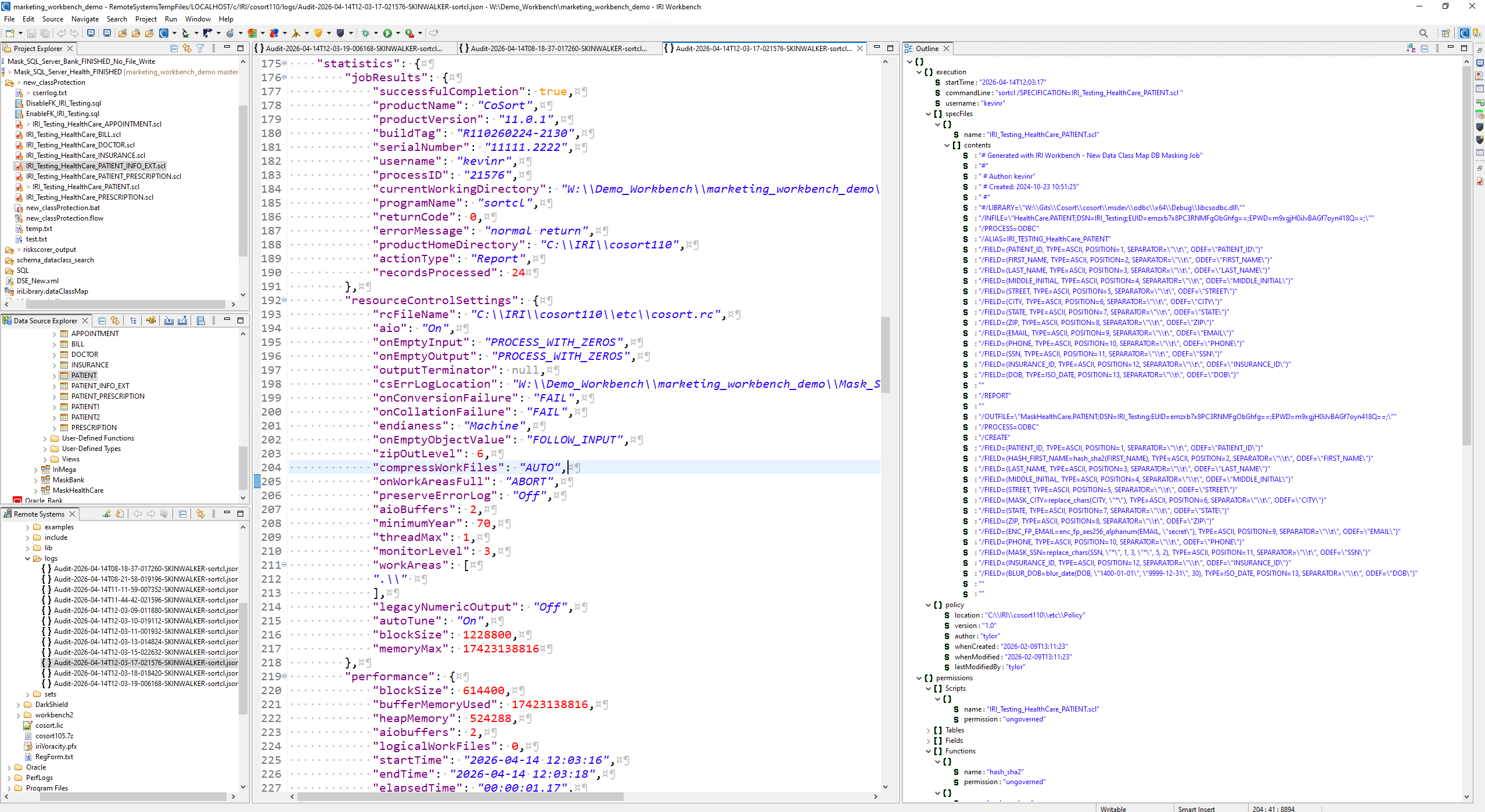
For data masking operations, all the source and target details -- and the masking functions applied -- are specified in self-documenting, human-readable job scripts, mapping diagrams, or configuration files, plus JSON-formatted logs produced by: IRI FieldShield, IRI DarkShield and IRI RowGen (which are all also included in the IRI Voracity data management platform).
In the case of FieldShield jobs, the audit trail contains the full contents of the script, plus the governed or ungovernened components therein. See this article on the Operational Governance System (OGS) infrastructure for these jobs, and note there is also a built-in log wrangling utility to query and export compliance and performance related information from the logs.
The log files (click on the screenshot below to expand) contain a comhrensive range of information, including:
- protection library function(s) used
- encryption keys or de-ID codes
- input and output tables or files
- user who ran the job and the Policy File in force
- job start, end, and elapsed times
- number of records processed through each phase, in total, and per second
Some of the data masking functions you can apply (ad hoc or as a rule), are:
- encryption and decryption
- anonymization via pseudonymization
- data blurring, hashing, deletion or scrambling
- de-identification and re-identification via twiddling
- partial or full-field redaction
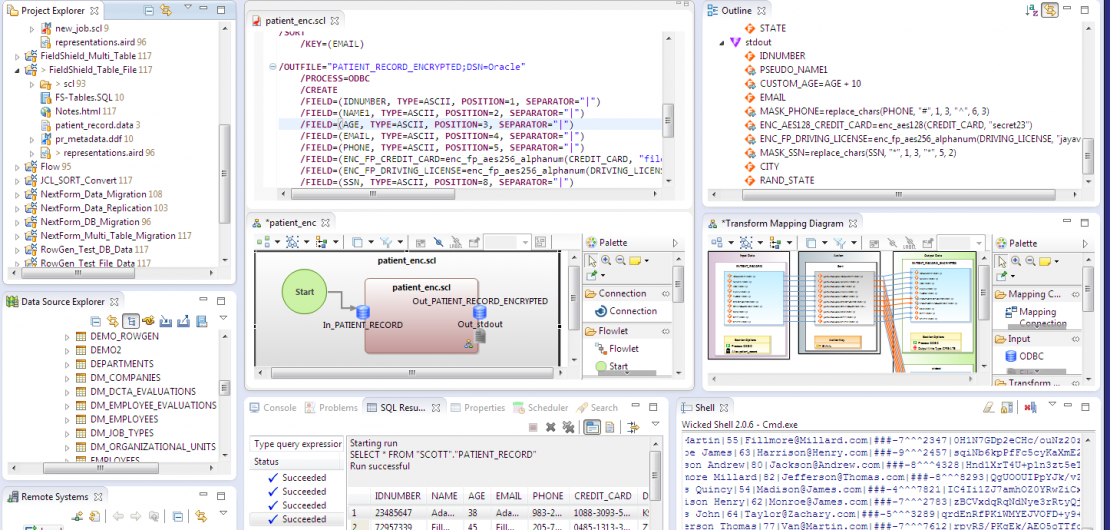
In addition to the PII discovery reports and de-identification job audit logs, compliance officers can also see the protection(s) applied in each exportable self-documenting job script or diagram. Once approved, the job can be saved or run on any local or remote server running the IRI data masking executable.
After execution, the job script can be isolated or shared, and modified or protected using Git for example, for reliable re-use in production.
In FieldShield, a re-ID risk scoring module is also supplied to statistically measure the likelihood of a data set being linked to an individual based on the unmasked quasi-identifying (demographic) attributes in their record. Further data anonymization techniques like blurring and bucketing to lower re-ID risk but preserve data utility for research and marketing purposes are included (see the HIPAA and FERPA tabs above).
In the case of IRI DarkShield, a comprehensive set of dashboard charts are produced to show data discovered (and if applicable, masked) in structured, semi-structured, and unstructured sources. One of those charts is a bubble chart to help you rank the PII risk in each data source; a kind of instant vulnerability assessment (heat map) resulting from aggregated data discovery (search) jobs:
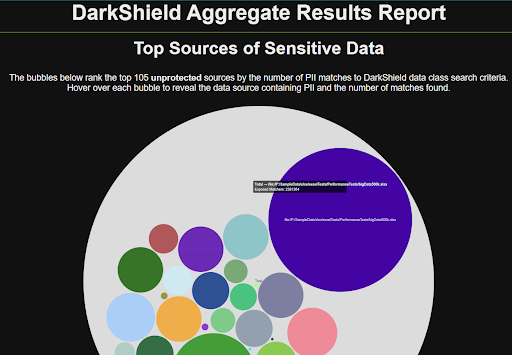
This data can also be audited in machine-readable searching and masking artifacts (JSON log files, including the one shown above) in IRI Workbench, or exported to SIEM tools like Splunk Enterprise Security, IBM QRadar, Microsoft Sentinel, Excel, and other SIEM/SOC and log visualization tools for further analysis and action.
In the case of IRI CellShield EE, both data discovery results and masking operation audit trails are provided in Excel, and linked for export to email, Splunk and Datadog.
The logs described on these page can show you how to protect PII and sensitive data, but are only part of the data privacy compliance solutions from IRI. To learn more about these logs and forensics in GDPR and HIPPA data masking generally, see this page. Also, check out the data lineage options on this page.
Related Solutions
Related Products
