
IRI Data Masking Tools in Gartner Market Guide
Gartner recognized solution for enterprise privacy.

Outsmart Risk. Classify, Find & Consistently Anonymize PII in Structured, Semi-Structured, and Unstructured Sources.
Classify, Locate, De-Identify, and Prove
Unmasked data can damage your company's reputation and cost it millions in fines. Award-winning on-premise data discovery and masking data anonymization tools from IRI have been repeatedly proven in a wide range of data breach nullification, privacy law compliance, and DevOps (test data) environments.
Use a fit-for-purpose IRI data 'shield' product (or more than one in the IRI Voracity data management platform) to find and mask sensitive data, preserve referential integrity, and prove it.
Whether you require static data masking for persistent storage, dynamic data masking or real-time protection, use a fit-for-purpose IRI data 'shield' product or the comprehensive platform to find and mask sensitive data while maintaining referential integrity in data masking.
- Types of Sensitive Data
Discover, De-identify, and Log Sensitive Data for Data Security Governance and Compliance
IRI data masking tools protect PII across any database, file, or cloud platform - no code changes required.
Talk to an Engineer
Comply with Data Privacy Laws
Data privacy laws require that key identifiers be encrypted, pseudonymized, redacted, or scrambled, and that quasi-identifiers be anonymized to prevent re-identification. IRI data and database masking tools can find and obfuscate PII in multiple structured, semi-structured, and unstructured sources to meet the data erasure, portability and rectification requirements of the GDPR et al, and score re-ID risk for HIPAA, etc. Inquire about your mandates.
Apply Multiple Masking Methods
Use the centralized data class and rule library for IRI FieldShield or DarkShield, built on Eclipse™, to discover, classify, and mask data quickly and easily. Blur, encrypt, hash, pseudonymize, randomize, redact, scramble, tokenize, etc. Pair a deterministic data masking function to your search-matched data classes, and apply it consistently to preserve realism and referential integrity enterprise-wide.
Learn more about Static Data Masking vs Dynamic Data Masking vs Real-Time Masking techniques.


Use Role Based Access Controls (RBAC) for Secure Masking
Decide and enforce who can access or use specific data sources and targets; masking rules and job scripts; data classifications and data layout definitions; decryption keys and log files; and, even the masking programs themselves. Establish different roles for different data sources, and different access rights based on those roles.
Leverage Multiple Audit Logs for Compliance Reporting
All IRI data obfuscation tools produce machine-readable audit logs that you can secure, query, and display, or export to SIEM tools, to: reliably document everything that's been changed, verify compliance with data privacy laws without tampering concerns, trigger alerts, and take action. This is how sensitive data auditing should work.


Enterprise Use Cases for Data Obfuscation Tools
- DevOps & Software Testing: Utilize static data masking tools to create safe, high-fidelity clones or masked refreshes of production data. This ensures your developers can work with realistic, synchronized datasets without risking exposure.
- Real-Time Analytics: Deploy dynamic data masking solutions to redact PII on-the-fly as it is queried by BI tools or third-party applications.
- Legacy System Migration: Securely move data to the cloud by applying data masking software during the ETL process, ensuring compliance from the moment data leaves your on-premise servers.
Learn Which Data Masking Tool to Use
 IRI FieldShield
Find, classify, mask, and risk-score PII across structured data sources, including legacy (flat COBOL, CSV, LDIF) files, ODBC-connected databases, cloud apps like Salesforce, etc. Use AES-256 FPE, blurring, hashing, redaction, pseudonymization, tokenization, etc.
Learn More → IRI DarkShield
Discover, deliver, and delete sensitive information in structured, semi-structured and unstructured sources, including: text, JSON, XML, HL7/X12/FHIR, SQL, and flat files, MS & PDF documents (including embedded images), Parquet, relational databases (plus C/BLOB and free-floating text columns), NoSQL DBs (MongoDB, Cassandra, Elasticsearch, CosmosDB, Redis, Splunk, etc.), DICOM and other image formats, signatures, audio formats, faces, and soon, handwriting too!
Learn More → IRI CellShield EE
Find, report on, mask, and audit PII in one or more Excel® spreadsheets at once using point-and-click options inside Excel itself. Search and mask intracellularly, protect formulas, and even entire sheets, too.
Learn More → IRI Voracity
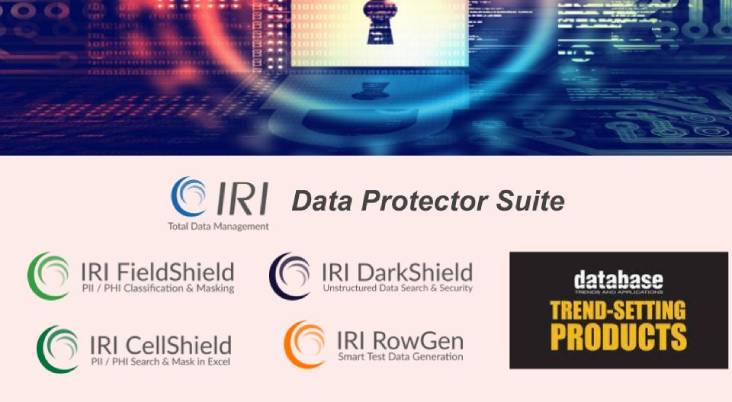
Get all three IRI data masking tools inside, plus test data management, within a total data lifecycle management platform that consolidates big data discovery, integration, migration, governance, and analytics. In addition to FieldShield, CellShield EE and DarkShield, Voracity includes IRI RowGen to generate synthetic, but realistic test data. Create (and mask) DB subsets, or generate smart test data from scratch for DB/ETL prototypes, analytic and AI models, product demos, and application or hardware stress-testing.
Learn More →Resources for Data Masking Software

Frequently Asked Questions (FAQs)
Deterministic masking functions like format-preserving encryption and pseudonymization, are vital data obfuscation tools because they ensure that the same input always yields the same masked output. This is critical for maintaining referential integrity in data masking across disparate systems.
Deterministic data masking functions retain a computational or tabular relationship to original data values so that when applied, will produce the same masked result for every unique original plaintext value every time. This ensures consistency in test values across databases to preserve referential integrity, and supports repeatable processes like test case validation and data synchronization. IRI facilitates this through the association of deterministic data masking rules (like format-preserving encryption and lookup pseudonymization) to data classes.
Types of Sensitive Data
- Personally Identifiable Information (PII)
- Protected Health Information (PHI)
- Primary Account Numbers (PANs)
- Other Sensitive Information
Personally Identifiable Information (PII)
While there is no set list of PII across all privacy laws, there are common elements used across these laws. In short, PII is information, when used alone or with other data, that identifies an individual. Government regulations like the CPRA, SSAE 18, SOC 2, and GDPR require that all PII be protected using specialized PII discovery and masking techniques within enterprise data anonymization workflows.
Protected Health Information (PHI)
In medical records, PHI identifies a health care recipient. US HIPAA regulations require that 18 key identifiers be effectively de-identified or anonymized.
Primary Account Numbers (PANs)
PANs are identifying numbers used in credit card transactions. The Payment Card Industry Data Security Standard (PCI DSS) requires card issuers, merchants, and testers to encrypt, tokenize, and otherwise protect this information.
Other Sensitive Information
Information like codes and formulas that constitute trade or military secrets need to be protected. You cannot afford to have this critical data lost in a data breach.
Sample Data Privacy Laws
- HIPAA
- GDPR
- FERPA
- FISMA
- FFIEC
- CPRA
HIPAA
The Health Insurance Portability and Accountability Act of 1996 (HIPAA) implements industry-wide standards for health care information. Health care providers, organizations, and their associates are required to develop and follow procedures for PHI when it is transferred, received, handled, or shared. It applies to all forms of PHI, including written, electronic, and oral.
GDPR
Under the General Data Protection Regulation (GDPR), all personal data of a citizen from the European Union must be secured. Companies are required to protect any data that can directly or indirectly identify an individual ("data subject"). These identifiers include, but are not limited to:
- Social Security Number
- Credit Card Number
- Bank Account Number
- First Name
- Last Name
- Address
- Zip Code
- Email Address
- Medical Information
- Genomic Information
- IP Address
- Geolocation Data
- Income and Tax Data
- Race, Ethnicity, and Religious Affiliation
- Sexual Orientation
- Trade Union Membership
- Birth Date
- Password
- Military ID
- Passport Number
- Driver's License Number
- Vehicle License Number
- Phone and Fax Numbers
The law also provides citizens with the Right to be Forgotten, or the ability to request that all information about them be removed from a company's possession. IRI data obfuscation products find that PII and PI you need in text, image, or facial form, and tell you where it is, and (immediately or later) automatically delete, deliver, and fix it so you can comply with GDPR right to erasure, portability and rectification provisions.
FERPA
The Family Educational Rights and Privacy Act (FERPA) is a federal law that protects the privacy of student records and information. FERPA gives rights and protections to parents and eligible students. Once a student reaches 18 years of age or enrolls in a post-secondary institution, he or she becomes an "eligible student," meaning all rights formerly controlled by the parents transfer to the student.
Under FERPA, a school may not generally disclose PII from an eligible student's records to third parties unless the student has provided written consent. Data protected includes PII and no less than the following additional information:
- Student Name
- Student ID Number
- Family Member Names
- Place of Birth
- Mother's Maiden Name
- Student Educational Records
- Immunization Records
- Health Records
- Individuals with Disabilities (IDEA) Records
- Attendance Records
FISMA
The Federal Information Security Management Act of 2002 (FISMA) is a federal law that recognizes the importance of data protection and information security to economic and national security interests. Every federal agency must develop, document, and implement an agency-wide course of action to secure the system and assets that support the agency, including those managed by another agency, contractor, or other sources.
Information that must be protected under FISMA includes PII and other sensitive information from these categories:
- Medical
- Financial
- Contractor Sensitive
- Security Management
- Other information specified by executive order, specific law, directive, policy, or regulation
FFIEC
The Federal Financial Institutions Examination Council (FFIEC) is a government inter-agency body that sets uniform principles, standards, and report forms to promote uniformity in the supervisions of financial institutions. Additionally, the Council oversees real estate appraisal.
Banks, credit unions, and other financial institutions are subject to the rules enacted by the Council. In addition to PII and Non-Public Personal Information (NPI), these institutions need to protect:
- Income
- Credit Score
- Collection History
- Family Member PII and NPI
CCPA (now CPRA)
The California Consumer Privacy Act of 2018 (CCPA) and the newer CPRA version, protects the data of Californians from being collected and mishandled. The law grants the citizens of California the rights to know all the information a business collects on them, to forbid companies from selling their data, to delete their data, and more.
List of PII PHI PANs Other Information
- Social Security Number
- Credit Card Number
- Bank Account Number
- First Name
- Last Name
- Address
- Zip Code
- Email Address
- Birth Date
- Passwords
- Military ID
- Driver's License Number
- Vehicle License Number
- Phone Number
- Fax Number
- Names
- Addresses / Zip Codes / Geocodes
- Dates
- Phone Numbers
- Fax Numbers
- Email Addresses
- Social Security Numbers
- Medical Record Numbers
- Health Plan Beneficiary Numbers
- Account Numbers
- Certificate / License Numbers
- Vehicle Identifiers
- Device Identifiers
- URLs
- IP Addresses
- Biometric Identifiers
- Facial Images
- Any Other Unique Identifiers
-
There is no list of PANs, as they are unique to individual accounts.
A PAN is a 14, 15, or 16 digit number generated as a unique identifier for a primary account.
- Codes
- Formulas
- Trade Secrets
- Military Information
- Classified Information
- etc.
